Advanced 1/3 Octave, 1/8 Octave acoustic testing, sound wave propagation assessment, and industrial noise impact evaluation.
Human ears perceive certain modulations of the atmospheric pressure as sound. Such modulations result from a propagated vibration of an elastic medium or superposition of such vibrations, causing alterations in pressure, stress, particle displacement, or particle velocity.
In the absence of acoustic energy, air molecules maintain thermal equilibrium. When a vibrating surface or pulsating sphere is introduced, molecules gain momentum and spread disturbances through waves of single frequency—detected by ears or microphones as sound. Unwanted, irritating, or unpleasant sound is classified as noise.
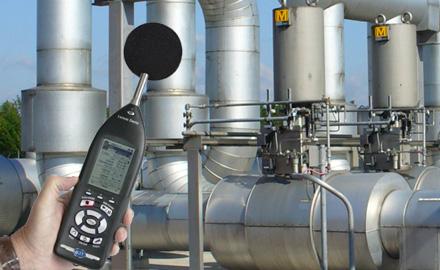
Excessive exposure to noise has numerous direct and indirect effects on safety and hygiene. It directly affects our sensation of hearing, disrupts sleeping, and causes masking of speech.
Otologists link industrial noise as a source of numerous problems of the ear, such as noise-induced hearing loss, permanent hearing impairment, acoustic trauma, sensorineural hearing loss, tinnitus, etc. Exposure to high noise levels can indirectly affect human psychology and physiology, resulting in adverse effects on general performances and various causal ailments.
Detailed breakdown of acoustic energy across frequency bands like 1/3 Octave and 1/8 Octave spectra for precise acoustic diagnostics.
Assessing workplace noise compliance to safeguard workers against hearing impairment and physiological distress.
Get in touch with Perfect Test House experts for comprehensive noise level analysis and industrial acoustic monitoring.
